
Why Exponential Equations Trip Students Up
If the variable in your equation is stuck up in the exponent, you can’t solve it with ordinary algebra alone; you need logarithms. This is one of the most common sticking points for students working through algebra II, precalculus, or exam prep, and it’s exactly what we’re breaking down in this tutorial.
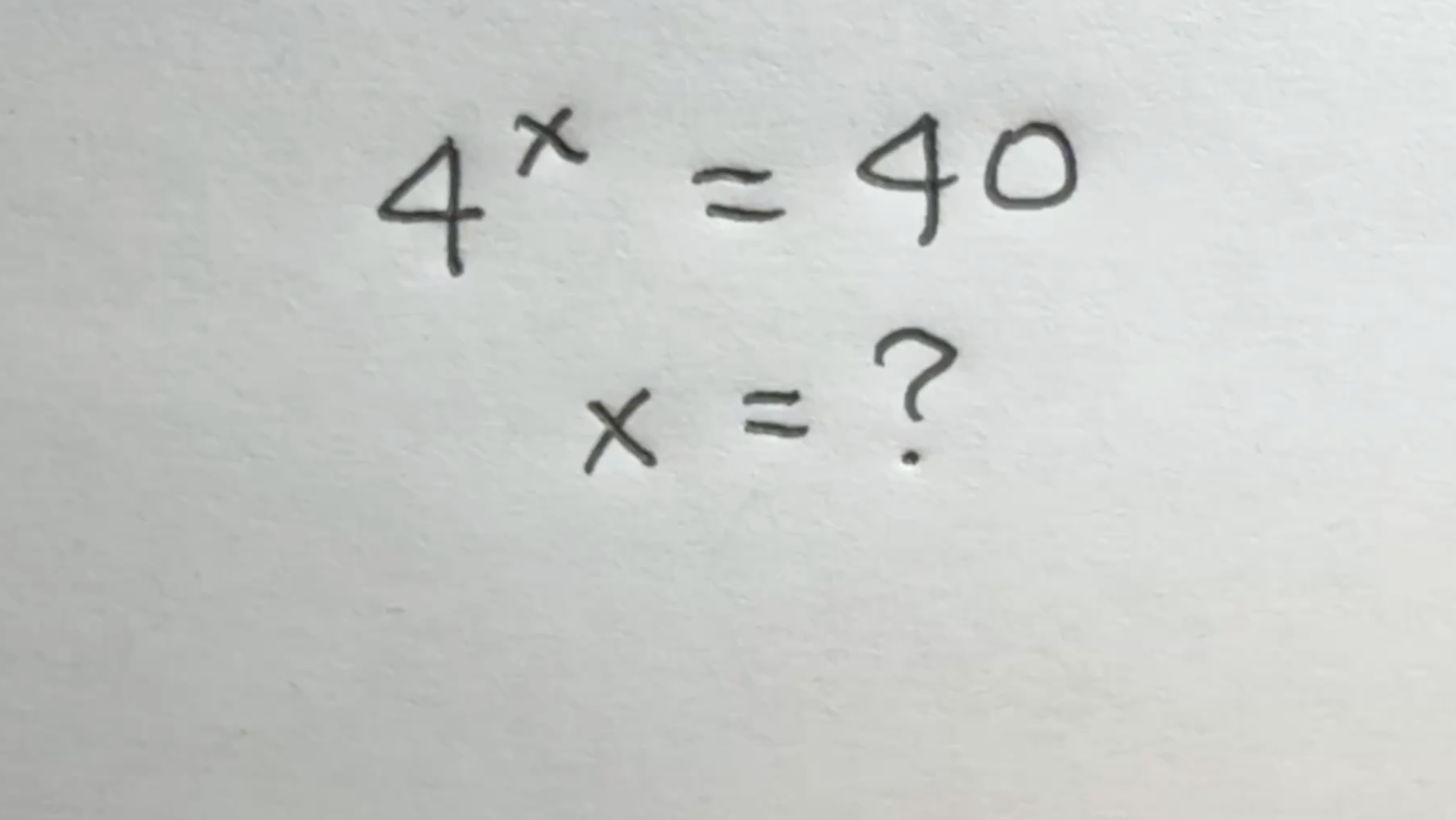
In this guide, we’ll walk through the full solution to the equation 4^x = 40, showing every algebraic step so you can apply the same method to similar problems in your homework or exams.
Read Also: How to solve for x in this algebra equation 5^x / 15 = 5 (Step-by-Step)
What Makes This Equation Tricky
At first glance, 4^x = 40 looks simple, but there’s no obvious integer value of x that makes it true. You know that:
- 4^2 = 16
- 4^3 = 64
Since 40 falls between 16 and 64, x must be somewhere between 2 and 3 — a non-integer, irrational solution. That’s your cue that logarithms are required.
Step 1: Break Down 40 Into Prime Factors
Before applying any logarithm rules, it helps to simplify the number on the right side of the equation. Breaking 40 into its prime factors gives us:
40 = 2³ × 5
This step matters because 4 itself can be rewritten as a power of 2 (4 = 2²), which lets us line up matching bases later in the process and simplify the expression more cleanly.
Step 2: Rewrite the Equation Using a Common Base
Since 4 = 2², we can rewrite the left side of the equation:
4^x = (2²)^x = 2^(2x)
So the equation becomes:
2^(2x) = 2³ × 5
This form makes the exponential relationship clearer, but since the right-hand side isn’t a clean power of 2, we still need logarithms to fully isolate x.
Step 3: Apply the Logarithm to Both Sides
To move x out of the exponent, take the logarithm (natural log or log base 10 both work) of both sides of the original equation:
ln(4^x) = ln(40)
Step 4: Use the Power Rule of Logarithms
The power rule of logarithms states that log(a^b) = b·log(a). Applying this rule brings the exponent down as a coefficient:
x · ln(4) = ln(40)
Step 5: Isolate x
Now divide both sides by ln(4) to solve for x:
x = ln(40) / ln(4)
This is the exact value of x, expressed in terms of logarithms — exactly what the problem asks for.
Step 6: Calculate the Decimal Approximation
Plugging into a calculator:
- ln(40) ≈ 3.6889
- ln(4) ≈ 1.3863
x ≈ 3.6889 / 1.3863 ≈ 2.661
This confirms our earlier estimate: x falls between 2 and 3, closer to 3.
Key Logarithm Rules Used in This Problem
To solve exponential equations like this one, you need to be comfortable with a few core logarithm properties:
- Power Rule: log(a^b) = b·log(a)
- Change of Base: log_b(a) = ln(a) / ln(b)
- Prime Factorization: simplifying numbers into their prime components before applying log rules
Mastering these three tools is the foundation for solving nearly any exponential equation you’ll encounter in algebra or precalculus.
Common Mistakes to Avoid
- Forgetting the power rule. Students often try to distribute the logarithm incorrectly instead of bringing the exponent down as a multiplier.
- Mixing up ln and log. Either works as long as you’re consistent on both sides of the equation.
- Skipping the prime factorization step. While not always required, breaking numbers into prime factors often reveals a common base that simplifies the entire problem.
Practice Problem
Try solving 3^x = 50 using the same method:
- Apply ln to both sides
- Use the power rule to bring x down
- Divide to isolate x
- Calculate the decimal approximation
(Answer: x = ln(50)/ln(3) ≈ 3.56)
Conclusion
Solving exponential equations like 4^x = 40 comes down to a repeatable process: identify a common base where possible, apply logarithms to both sides, use the power rule to bring the exponent down, and isolate x. Once you’ve internalized these steps, you can apply the same method to virtually any exponential equation.
Want more breakdowns like this one? Subscribe for weekly math tutorials that simplify complex algebra concepts, and drop a comment with a specific equation you’d like solved next.
Watch the full video tutorial on solving 4^x = 40 step by step on our YouTube channel.