
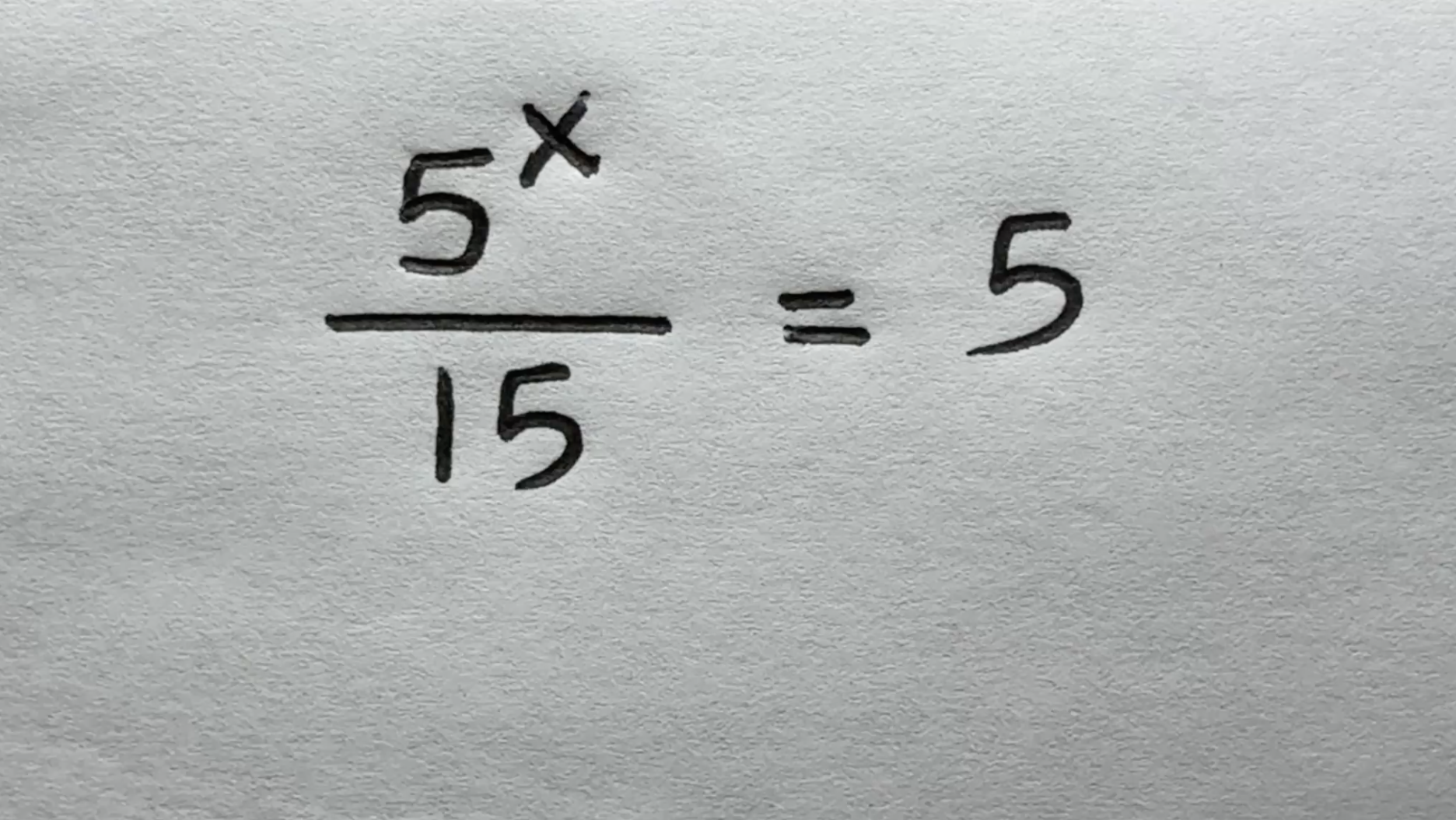
Exponential equations often look intimidating at first, especially when the variable appears in the exponent. However, many of these problems become surprisingly straightforward once you identify the first algebraic step. In this tutorial, we’ll solve the equation 5^x / 15 = 5 using clear, step-by-step reasoning.
Whether you’re studying algebra, preparing for an exam, or simply sharpening your problem-solving skills, understanding the thought process is much more valuable than memorizing formulas. Once you learn the strategy behind this example, you’ll be able to apply the same ideas to many similar exponential equations.
Read Also: How to solve for x in this algebra equation 3^x × 9^x = 18 (Step-by-Step)
If you’d like to follow along visually, you can also watch the complete video solution below.
Problem
Solve for x:
5^x / 15 = 5
Before reaching for logarithms or more advanced techniques, take a moment to look at the structure of the equation. A common mistake is to assume that every exponential equation requires logarithms. In reality, many problems can be solved using only basic algebra and the laws of exponents.
The first goal is to isolate the exponential expression.
Step 1: Eliminate the denominator
Since 5^x is divided by 15, multiply both sides of the equation by 15.
5^x = 75
At this point, the fraction has disappeared, leaving us with a much simpler equation.
Step 2: Compare the result with powers of 5
Now ask yourself whether 75 is a power of 5.
Some nearby powers are:
5^1 = 5
5^2 = 25
5^3 = 125
Since 75 is not an exact power of 5, we cannot determine x by inspection. This tells us that the next step is to use logarithms.
Step 3: Apply logarithms
Take the logarithm of both sides.
log(5^x) = log(75)
Using the power rule for logarithms,
x log(5) = log(75)
Now divide both sides by log(5).
x = log(75) / log(5)
Using a calculator,
x ≈ 2.6826
Final Answer
x = log(75) / log(5)
Approximate value:
x ≈ 2.6826
Why This Method Works
The most important idea in this problem is recognizing that the exponential term should be isolated before applying logarithms. Multiplying both sides by 15 removes the fraction and leaves a much cleaner equation.
Only after checking whether 75 is an exact power of 5 do we introduce logarithms. This keeps the solution as simple as possible and avoids unnecessary steps.
Whenever you encounter an exponential equation, it’s worth asking yourself whether the number on the opposite side can be rewritten as a power of the same base. If it can, you may not need logarithms at all. If it cannot, logarithms provide a reliable method for finding the exact solution.
Common Mistake
A frequent mistake is taking logarithms immediately without first simplifying the equation.
Although that approach still works, it often creates extra steps. Isolating the exponential expression first usually leads to a cleaner and easier solution.
Another mistake is assuming that 75 equals 5^2 or 5^3. Checking a few nearby powers quickly shows that this is not the case, which tells us that a logarithmic approach is needed.
Practice Similar Problems
If you understood this example, try solving these next.
- 2^x / 8 = 4
- 3^x / 9 = 27
- 7^x / 14 = 49
- 10^x / 20 = 50
Each problem follows the same general strategy: simplify the equation, isolate the exponential expression, and then decide whether logarithms are necessary.
Continue Learning
If you enjoy solving exponential equations step by step, explore the rest of our algebra tutorials. Each lesson focuses on a different problem while explaining the reasoning behind every step, helping you build confidence rather than simply memorizing procedures.